Breed Guide
Doodle Haircut Styles: Teddy Bear, Puppy, Lamb and Kennel Cuts Explained
Two owners can ask for a teddy bear cut and picture two different dogs. Here is what each popular doodle cut really means, how much brushing it asks of you, and how to describe the look you want.
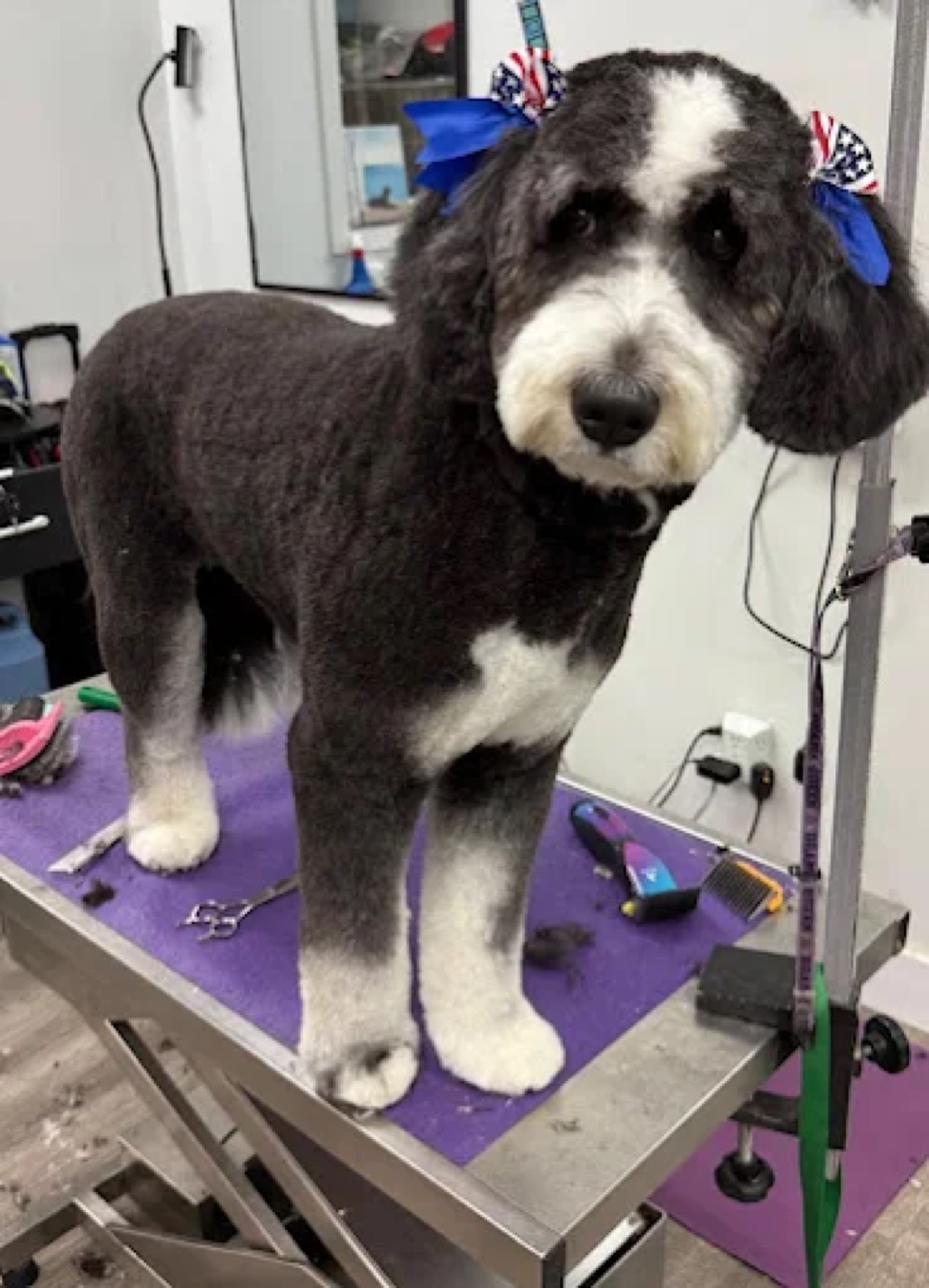
"Just a teddy bear cut, please." We hear that sentence at the front desk all the time, and here is the funny part: two doodle owners can say those exact words and picture two completely different dogs. One means a round, fluffy face with a short body. The other means a long, plush coat all over that makes the dog look like a stuffed animal. Neither of them is wrong, because doodle haircut names were never standardized.
We have been grooming in Miami Lakes since 2003, and in that time doodles have gone from an unusual sight to one of the most common dogs on our table. After all those hours with the scissors, we can tell you that the name of a cut matters much less than the details behind it: how long the body is, how full the legs are, how the face is shaped, and what happens with the ears and tail. Get those details across and you will walk out with the dog you pictured.
Here are the four doodle cuts owners ask for most, what each one involves, how much brushing it asks of you, and how to describe the cut you want so nothing gets lost in translation.
How to ask for a doodle cut in one breath
Tell us four things: the body length you want (show it with your fingers), the face shape (big and round or short and clean), what to do with the ears (natural length or trimmed short), and the tail (full plume or tidied). Then show us a photo of a dog you like and tell us how much brushing you realistically do each week. That last part decides more than you would think.
Why doodle cut names are so confusing
Poodles have a show tradition with named clips that groomers learn and judges recognize. Doodles do not. Doodle cut names came from owners, groomers, and social media, and they drift from salon to salon. A "puppy cut" in one shop is a short, practical trim. In another it means anything that is one length all over.
The coat itself adds to the confusion. Doodles are mixes, so the coat can be tight and curly like a Poodle's, loose and wavy, a soft fleece somewhere in between, or even fairly straight like a Golden Retriever's. The same "teddy bear cut" looks different on each of those coats. A curly coat holds a round, sculpted shape well. A straighter, wavier coat lies flatter and looks shaggier at the same length. So when you show us a photo, part of our job is telling you honestly how close your dog's coat can get to that picture.
The teddy bear cut
The teddy bear cut is the doodle style owners ask us for most often, and the heart of it is the face. The head is scissored into a soft, round shape, the hair over the eyes is cleared so your dog can see, and the muzzle is trimmed shorter so the whole face reads as round and gentle. The body is usually left at a medium length, often somewhere around an inch, and the legs are left a little fuller than the body so the dog looks plush and balanced. Feet are rounded so they look neat instead of like slippers.
It is soft and cuddly while still being practical. The catch is that a round, full head means more hair around the ears, cheeks, and chin, and those are exactly the places doodles mat first. Food, water from the bowl, and drool all end up in the beard and the cheek hair. If you choose a teddy bear cut, plan on combing the face and behind the ears every day or two, along with the body.
Good fit for: owners who love the classic fluffy doodle look and are willing to comb the face and ears often.
The puppy cut
A puppy cut is the simplest idea of the four. The coat is trimmed to roughly the same length all over the body and legs, following the dog's natural outline, so the adult dog looks a bit like it did as a fluffy puppy. The face is usually tidied and rounded, but not sculpted as dramatically as a teddy bear head.
The useful thing to know is that "puppy cut" says nothing about length on its own. We have seen puppy cuts at half an inch and puppy cuts at two inches, and they look like different dogs. So if you ask for a puppy cut, tell us the length too. In Miami heat, a lot of families land in the shorter half of that range, because it keeps the dog comfortable and dries faster after a bath, a rainstorm, or a swim.
Good fit for: busy households who want an even, low-fuss look that grows out evenly between appointments.
The lamb cut
The lamb cut borrows from Poodle styling. The body is kept shorter and the legs are left noticeably fuller, so the dog looks like it is wearing fluffy leg warmers. The head and topknot are usually rounded, and the transition from short body to full legs is blended with scissors so it looks smooth rather than like two different haircuts on one dog.
It is a sharp, polished look, especially on curly-coated doodles, and the short body is a nice break in the heat. The trade-off is the legs. Long leg hair touches everything: wet grass, sand, mud from the afternoon storms. Fuller legs pick up debris and tangle faster, especially in the armpits and on the backs of the legs, so that is where your brush should spend most of its time.
Good fit for: owners who want a stylish, structured look and do not mind brushing legs several times a week.
The kennel cut
The kennel cut is the practical one. The coat is clipped short and fairly even over the whole body, usually with a short, tidy face to match. It is the easiest cut to maintain at home, and it buys you the most time before tangles become a problem.
It suits dogs who swim in the pool or splash in the canals, dogs who spend a lot of time outside, households without time to brush several times a week, and dogs with a history of matting. It is also the length we often recommend as a reset when a coat has gotten away from you.
Short does not have to mean shaved to the skin. Unless matting leaves us no choice, we like to leave a little coat on the body. A thin layer of hair still shields the skin from strong South Florida sun and from scrapes, and many owners are surprised by how soft and doodle-like a short cut can still look.
Good fit for: swimmers, outdoor dogs, busy families, and any doodle that mats easily.
Faces, ears and tails: the details that change the whole look
Two dogs with the same body length can look completely different because of these finishing details.
The face
A big, full round head looks plush and dramatic. A smaller, shorter round looks clean and keeps food out of the beard. If the beard always smells like breakfast, ask for the face a bit shorter. Either way, we keep the hair around the eyes cleared so your dog can see.
The ears
You can keep the ear hair long so it blends into the head, or trim it shorter so the ear shape shows. Longer ear hair looks soft, but it mats fast, especially right behind the ear where the collar and the ear leather rub together. Shorter ears are easier to keep clean and dry, which matters in our humidity, because doodle ears are already warm and floppy.
The tail
A full, feathery plume is the classic doodle tail. Plenty of owners keep the plume and ask us to tidy the underside so it stays sanitary.
Matting decides the length more than the photo does
Here is the honest part, the one we wish every doodle owner heard before booking. The cut you can have depends on the coat that walks in the door. If the coat is brushed out and tangle-free all the way to the skin, we can do almost any style and length you ask for. If the coat is matted, the mats decide.
A mat is a tight pad of tangled hair sitting against the skin. We cannot scissor a teddy bear head out of it, and brushing out a heavy mat pulls and hurts. In that situation the kind and safe choice is to clip underneath the mats and take the coat short, then let it grow back into the style you want with a better brushing routine. We will always talk you through it before we do it, and we will never pretend a matted coat can be turned into a fluffy cut in one visit. Our guide to doodle grooming and matting goes deep on why doodle coats knot up so easily and how to stay ahead of it.
The simple rule we give owners: you can only keep the length you can brush. If you love a longer, fuller look, the brushing has to match it. If that brushing realistically will not happen, a shorter cut is the one that will actually look good and feel good for the next several weeks.
If we see something under the coat
A haircut is also a full look at your dog's skin. If we find redness, sores, lumps, fleas, or irritated ears while we work, we will tell you the same day. We are groomers, not vets, so anything that looks like a skin or health problem is a question for your veterinarian, and we will say so plainly.
Choosing a cut for South Florida life
A doodle in Miami Lakes lives a different life from a doodle in a cold, dry climate, and the cut should reflect that.
- Longer coats stay damp longer. After a bath, a downpour, or a dip in the pool, a long, dense coat can hold moisture against the skin for hours. Damp coats tangle faster and can lead to skin irritation.
- Water dogs do better short. If your doodle swims in a pool, a lake, or the canal behind the house, a shorter cut rinses and dries much more easily.
- Shorter is more comfortable in the heat. Most doodles do not carry the dense undercoat of a Husky or a Pomeranian, so a moderate trim does not strip away insulation they depend on. It simply means less hair holding heat and humidity against the body.
How to ask your groomer for the cut you want
Most haircut disappointments come from a gap between the words used and the picture in someone's head. A few habits close it.
- Bring a photo of a doodle with a similar coat. A tightly curled doodle in a photo will not translate to a wavy one.
- Show the length with your fingers. "Short" and "long" mean different things to different people. Holding your fingers apart over your dog's back is clearer than any adjective.
- Tell us what you did not like last time. Too short on the face, legs too bulky, ears too long. That feedback helps most.
- Be honest about brushing. We will not judge you. We will just recommend a length you can keep.
- Stick with the same groomer. Every time a new person cuts your dog, the look drifts a little. With us, the same people who answer the phone are the people grooming your dog, one dog at a time, with no rotating crew, so the cut stays consistent from visit to visit.
Which service gets your doodle a haircut
A styled doodle cut of any kind is a Full Service groom: the bath, nails, ears, anal glands, and teeth brushing, the face, feet, and sanitary tidy, then the full haircut and body styling with a cologne finish. Between full cuts, our Grooming service keeps the face clean and the feet rounded with a hand-scissored finish, without a body cut, while the length grows in. Our services page lays out exactly what each level includes. Every dog is priced individually by coat type and condition, which for doodles mostly comes down to how much coat there is and how well it has been brushed.
How often a doodle needs a haircut
Most doodles look and feel best with a full cut every four to six weeks and brushing at home several times a week in between. Longer, fluffier styles need the shorter end of that window, and kennel cuts can stretch a little longer.
Doodle families are some of our most regular members for exactly this reason. With the Paws Membership, your doodle can come in as often as every week or every two weeks, always with the same groomers, with priority scheduling and no surprise dematting fees, because a coat cared for that often simply stays knot-free. It is the easiest way we know to keep a fluffy style looking the way you wanted it on day one.
The short version
Doodle cut names are not standardized, so ask for details rather than a label. A teddy bear cut means a round, fluffy face with a medium body. A puppy cut is one length all over, so say which length. A lamb cut keeps the body short and the legs full. A kennel cut is short and practical everywhere. Bring a photo of a dog with a similar coat, show the length with your fingers, and pick a length you can actually brush, because a matted coat will choose the length for you. In our humidity, shorter cuts dry faster and stay comfortable.
If you are not sure which cut suits your doodle, bring them by or send us a photo on WhatsApp at 305-619-9784. We will look at the coat and tell you honestly what it can do.
Frequently asked questions
What is a teddy bear cut on a doodle?
A teddy bear cut gives a doodle a soft, round, scissored face with a shorter muzzle and clear eyes, with the body usually left at a medium length and the legs a little fuller. The exact length varies from salon to salon, so tell your groomer how long you want the body and how full you want the face. It looks plush and cuddly, but the face and ears need regular combing to stay tangle-free.
What is the best doodle haircut for the Florida heat?
For most doodles in South Florida, a shorter puppy cut or a kennel cut is the most comfortable and practical choice. Shorter coats dry faster after baths, rain, and swimming, and they tangle less in the humidity. You can still keep a round, fluffy face if you like the teddy bear look. We usually recommend leaving a little length on the body rather than shaving to the skin.
Can you give my matted doodle a teddy bear cut?
If the coat is matted close to the skin, usually not on that visit. Mats cannot be scissored into a fluffy shape, and brushing out heavy mats hurts. The kind approach is to take the coat short underneath the mats and let it grow back into the style you want with regular brushing. We always talk it through with you before we start.
How often does a doodle need a haircut?
Most doodles do best with a full haircut every four to six weeks, plus brushing at home several times a week. Longer, fluffier styles need the shorter end of that range. Dogs on our Paws Membership can come in as often as every week or every two weeks, which keeps the coat knot-free and the style consistent.
Not sure which cut fits your doodle?
Bring your doodle in or send us a photo on WhatsApp. We will look at the coat, talk through the face, ears and length, and recommend a cut you can actually keep up with.